Our project changed courses more than a few times throughout this semester. However, after reading Devon Mihesuah’s book, we narrowed down our focus. If you look at the Idaho History Education Standards you will find that there is one small mention of Native American history and it seems only relevant in its relation to European settlers. So, we decided to completely rewrite the standards so that our students could get an understanding of 1) the complexity of what it means to be “Native American”, 2) the significant difference between studying Native American history as it occurs to “outsiders” versus studying (in our case) Blackfoot Native American primary and secondary documentation, 3) the culture (gender roles, religion, rituals, etc) of Blackfoot Native Americans. As Mihesuah states in her book, “There is no such thing as a monolithic, essential Indigenous woman.”
Attached below is our lesson plan, the assignment sheet for the summative assessment, as well as a picture of the beaded moccasins.
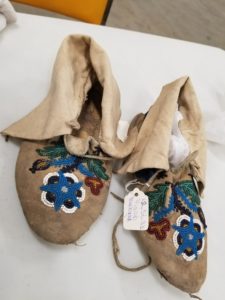
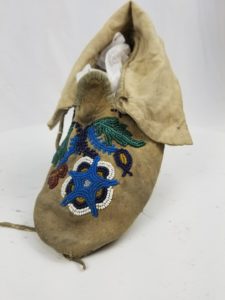
Blackfoot Native American Lesson Plan
Sources:
Ewers, John C. The Blackfeet: Raiders on the Northwestern Plains. University of Oklahoma Press, 1958.
Samek, Hana The Blackfoot Confederacy 1880-1920: A Comparative Study of Canadian and U.S. Indian Policy. University of New Mexico Press, 1987.
Wissler, Clark Material Culture of the Blackfoot Indians 1870-1947. AMS press, New York reprint of 1910 ed. 1975
Lewis, Oscar The Effects of White Contact Upon Blackfoot Culture, with Special Reference to the Role of Fur Trade. Centennial Anniversary Publication The American Ethnological Society.
University of Washington Press Seattle and London, 1942
https://www.warpaths2peacepipes.com/indian-tribes/blackfoot-tribe.htm
SaveSave