Shoe Details
This is a black pair of shoes with two-inch heels. They are made of faux leather in the inside with black silk and acetate fabric on the outside of the shoe. Although they appear to be on perfect condition on the outside, the wooden soles appear well used and discolored. The shoe laces are silk and appear modern except for the ends where the aglets does not extend to the end of the lace. Instead, the laces have a frayed end that looks like a paintbrush. On the insole lining of the right shoe is a label: “Cinderella Shop Boise, Ida.”
Idaho State Historical Society, 1964.127.26/1-2
Historical Context
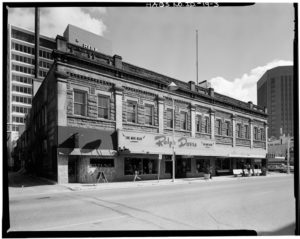
The Cinderella Shop opened in 1927 in the Montandon Building on W. Idaho St. The store included a retail area on the first floor and a business and restroom area on the second floor. The shoes themselves were bought in 1928. At the time, popular styles included silk and satin and often took inspiration from Chinese and Japanese textile traditions. Of course the biggest source of fashion trends, even in Boise, was Paris.
Every fall, the apparel stores in Downtown Boise would hold fashion shows to showcase the newest trends of the season. These included beautiful window displays and live models (often called mannequins in the larger fashion shows of the time) to show off the latest fashions. The Cinderella Shop was a regular participant. Offering both the newest fashions and the chance to buy with credit, the Cinderella Shop was a natural addition to Boise’s fashion center and remained open until 1939.
It is obvious from the materials used in the shoes and the store from which they were bought that the woman who owned these shoes was at least somewhat invested in the fashions of her time. Given how nice the materials are and the shoes’ near perfect condition, it is likely that these shoes were one of several pairs of shoes owned by an upper-class woman. Due to the arrival of automobiles in Boise around this time, the woman who wore these shoes was most likely experiencing a new sense of freedom that would not have been available to women just ten to twenty years before. This would have given her more opportunities to socialize and shop. It would have also influenced a desire to wear shorter skirts that were more practical for driving.
Narrative
The Cinderella shoes tell their own happily ever after. The shoe was purchased from the Cinderella shop in Boise, Idaho back the late 1920s. Who would have thought this magical shoe would take off to so many upper-class white women of the city. The new spring and fall fashion of the year was the perfect fit for the “it” girls of the city. The ones who wanted to impress people out in the street would wine and dine. The mothers who went on their daily shopping trips and for the girls who want to go out on the town. To dance the night away while looking fabulous as ever. The Cinderella shoe made every woman feel as though as they were living the fairytale life. Cinderella shoe went with the latest fall clothing the fur coats, dresses, and millinery. The upper-class women wore the latest trends. And to top it all off the fairy godmother that was the Cinderella shop, helped these women find their silk slippers to go to the ball. Or in this case the parties of the roaring twenties filled with jazz music and flappers. This shoe was perfect for any kind of season, except winter, it was the shoes that women wore as soon as they got out the house. To take a stroll to the park, running errands and getting ready for their little get together with their friends to gossip.
The care of the shoe, being so well taken care of by the women who owned it tells a lot about them and who they were as a person. These women knew how to dress up nicely for a night in the city. They knew when and where to specifically wear the shoe out as well as using them to make a statement about who they are in this city. Where they stand on top of the social hierarchy and the people they surround themselves with. These women made it known they were the “it” girls of the town and anybody whos anybody wanted their life. They knew the life of the parties was where it was at.
Conclusion
Every shoe has a story. The true story of these shoes may be forgotten, but history has left its mark on them and they have left their mark on history. By the way, the shoes were left behind, we can construct a story of an upper class woman in Boise and how she may have lived. She was a woman who dressed well and for the times, but she also made good use of her clothes. She did not just wear these shoes once and put them back in the closet; she enjoyed them.
These shoes also suggest that Boise had a thriving fashion industry that catered to those who wanted to stay up to date with the latest trends. The high-fashion lifestyle that is today so heavily associated with the 1920’s was not just limited to the East Coast. Women in the West were enjoying the same newfound freedoms that came with the arrival of automobiles and more liberal views of how a woman can dress and behave.
Bibliography
“Boise Style Show Opens This Evening.” Idaho Statesman, Sept. 14, 1927.
Cinderella Shop. “Luxurious Furred Winter Coats.” Newspaper Advertisement, Idaho Statesman, Oct. 1, 1929.
Evans, Caroline, “Jean Patou’s American Mannequins: Early Fashion Shows and Modernism.” Modernism/Modernity 15, No. 2 (2008): 243-263.
Historic American Buildings Survey, Creator, and John W Smith. Montandon Building, 722 West Idaho Street, Boise, Ada County, ID. Ada County Boise Idaho, 1933. Documentation Compiled After. Photograph. https://www.loc.gov/item/id0018/.
“New Women’s Store Opens.” Idaho Statesman, Aug. 12, 1927.
“One of Idaho’s Finest Stores for Women’s Wear Announces Closing Out Sale.” Idaho Statesman, Oct. 22, 1939.
“SHE SAYS — A Statesman Special Feature Devoted to Things Feminine.” Idaho Statesman, Sept. 18, 1927.
Wells, Merle W., and Arthur Hart, Boise: An Illustrated History. Sun Valley: American Historical Press, 2000.