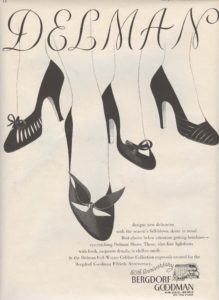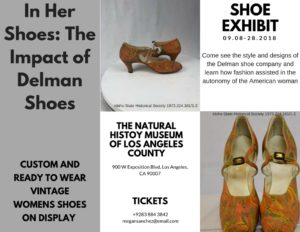
“How grateful am I to the God of Style— or is it the Goddess of Fashion?— that I may wear as few clothes as possible. As to heels— well, I may wear them high or low, as I choose.”
—Fashion Comment, New York Times, 1927
With the finalization of World War I, women in America found themselves amid a national increase in wealth and income, but in this new era, they too participated in the work force producing their own disposable income. The rapid industrialization and urbanization caused by a wartime economy now provided the resources and technology for mass produced goods and an influx in consumerism on a larger scale. Contradicting traditions of frugality and conservation, women in America pushed up against the boundaries of a previous Victorian era to demand suffrage and challenge the social conventions in place. No longer content with the passivity and confinement to the private sphere, the first wave of feminism challenged not only the political order, but also reflected the symbolic meaning of women’s mobility as fashion evolved. Women largely showed discontent with remaining the guardians of pure morality, instead, challenging social conventions not only in terms of fashion, but also overall life styles and their attitudes.
Women’s pursuit of physical freedom from cumbersome long, heavy skirts, restricting corsets, and ill-fitting, dysfunctional footwear created a social paranoia that translated as women intending to compete with men and leave their homes and children unmanaged. Although widely accepted that men dressed to express their socio economic status, women incorporating individuality into their own fashion taste was analyzed as an attempt to overtly flaunt their sexuality to attract men through body exposure and paying too much attention to their own extravagant appearance. However, the shift toward creating fashion styles based on mobility, comfort, and unique stylization connoted women’s rights of expressing personal taste in fashion as a citizen with the gain of suffrage. Shoes became an intricate facet of self expression and mobility where previous footwear hidden under ground sweeping skirts made little deviation or evolution over the years. With the rise of the hemline, shoes made an appearance as a staple of apparel with “a shoe for every mood and one for each of about 999 purposes.” Women solidified their power of swaying fashion and style trends as they refused to passively adapt already existing norms, instead forcing style to meet their own growing taste and needs.
An article from the New York Times quoted, “We no longer wear high collars and tight corsets, why is it we still encase our feet in tight uncomfortable shoes?” Women embraced wearing shorter skirts and accenting their individual taste in footwear, furthermore, wearing shoes that fit their actual foot size, whereas the previous fad for small feet made true-to-foot-size fitting uncommon. Challenging social and gender conventions with increasing mobility created a sphere for upper class women to participate in sports and navigate city streets on foot as well as enabled those participating in the working class held wage labor jobs with greater ease. Socio economic status was illustrated in much the same way as males exhibited their own social standing in fashion style. The evolution of the heeled shoe not only gave the illusion of a smaller foot, but also through design and achieving the constantly shifting trends of up-to-date fashion, acted as a symbol of status and leisure. Women now embraced the idea of footwear styles as the foundation for their “costume for the occasion” whatever that may have been, forcing the production and stocking of properly sized shoes in all colors and sorts of fabrics.
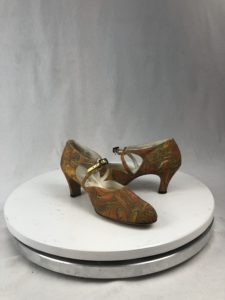
At the very beginning of the 1920’s, shoe manufactures contradicted women’s sense of choice and individualized sense of fashion by producing solely French heeled shoes making it almost impossible to find footwear with a medium sized heel. Implementing their newly found socio economic power, women dramatically decreased their consumption, resigning instead to avoiding purchasing the weekly mass outputs of the limited styles. Manufacturers were forced to then adhere to the styles woman kind demanded, a victory for women as individual consumers. Elizabeth Jordan responded to this phenomena in her column for The Los Angeles Times, “So the average woman may take courage. She is not as helpless a she imagines herself to be.” Women no longer acted content as passive adaptors of fashion, style needed to meet their growing taste and need in order to be widely accepted.
Fashion, especially that of footwear, acted as a style politic for women exiting the successful suffragette movement. After challenging political boundaries, women gained much power and independence further enabled in their participation in the work force economy. Although footwear seems like a small piece of an overall wardrobe and fashion statement, the mobility well fitted and intentionally designed shoes was monumentally symbolic. The refusal of continued adherence to Victorian era social and dress norms propelled women into a new era of self expression and autonomy.