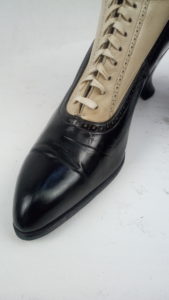
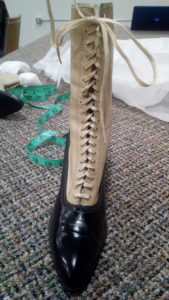
The Prown method, named for its developer Jules Prown, is a method of discerning information about a historical item. The steps in this method are description, deduction, and speculation.
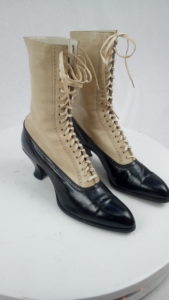
So, for an example, I’ll show how the Prown method can be used to infer about our boot.
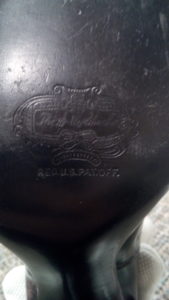
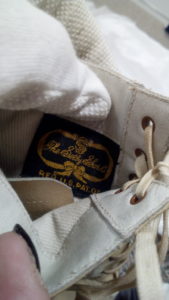
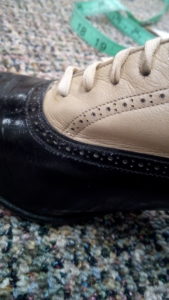
Description: a black and tan boot, presumably leather, in rather good condition, presumably hand assembled but possibly machine stitched, has a stamp on the bottom presumably from the manufacturer that matches a tag found inside, the Top and bottom appear to have been separate parts at one point
Deduction: From what I know about period fashion, I can give an educated guess that this boot was manufactured between 1890 and 1920. It utilizes laces rather than a button closure, so I can further narrow the window to from 1910 to 1920, and as fashions drastically changed from the teens into the 20s, I would further reduce the age window to between 1910 to 1919.
Speculation: I presume this is a woman’s boot, most likely a wealthy woman’s boot, and could be a walking boot; it was not worn often as the stamp on the sole is still largely intact. As the upper and lower sections are both leather, and two seperate colors, as well as the hand-tooled design between sections, I would venture to speculate this boot was not cheap, was not kept in-shop, and was most likely ordered specially and sent away for by local shoe purveyor.
The Prown method allows us to gather possible information to logically fill in gaps about items we might not know much about otherwise.